This is the 52nd - and therefore the last - posting here at the Weekly Gazelle. Thank you for checking in occasionally for some servings of Gazelle, and hopefully you were able to enrich your English vocabulary with all types of Dutch words (especially the profane ones). Besides the (admittedly small) entertainment and educational value, I hope this weblog will continue to be a valuable reference, because as we all know, once something is on the internet, it must be true. It is only a matter of time before these 52 words are incorporated into the Oxford English dictionary.
However, until this time, we will gradually work to fill in the gaps on Urban dictionary, such as this entry on 'muts'. In this manner, The Weekly Gazelle will make a small, but valuable contribution to humanity. Some, like zwaffle, is already an entry, but there are many glaring holes in the Dutch-to-English language crossover.
For the last 52 weeks, we want to express our thanks in the most Gazellish way possible. "Bedankt" is the how they say "thanks" in Dutch, but when people say it, it sounds more like "ba-donk". So, here is a big song and dance number from an episode of the Late Late Show with Craig Ferguson where he lip-synched Trace Adkin's Honkey Tonk Badonka Donk using puppets (Wavey the Crocodile from the South and Brian the gay shark), three smoking-hot dancers and the intern who always wears bondage leather. It seems like the perfect ending to the year of the Gazelle.
Badonka donk is perfect for those situations where you want to say thanks without seeming too serious, or when talking to a Dutch person and don't want to embarrass yourself with trying the proper pronounciation of the Dutch language. Either way, it can inject a little gazelle into an otherwise mundane moment.
Example Sentences:
"Badonka donk for reading, and keep on having that Gazelle for 2011 and beyond."
People love their holidays. Hell, if most people had the choice, they wouldn't work at all. That's why they have to pay you to come to your job. Anyway, Christmas is one of those times of year that most of the people in the world puts aside their personal beliefs and pretends that the imaginary birth-date of an important religio-historical figure entitles them to a couple of days off work. (They also do this to celebrate his death-day also which is often an entire long weekend.)
It is only natural that we would want to stretch out the holiday as much as possible, and many countries do with a holiday on the 26th of December. In many commonweath countries, there is Boxing Day which is sometimes called "Saint Stephen's Day", in South Africa it is called the Day of Goodwill, and a bunch of other countries have their own names for what is essentially takaing advantage of the Christian Tradition. (He also died for our public holidays apparently.) However, why don't we cut the crap a little bit and stop pretending that the 26th of December is a day for "goodwill" or for cleaning up the empty boxes or whatever the lame explanation for that name is? It is just a holiday to stretch out Christmas, hence, the 2nd Christmas.
This is apparently a term used all across Europe, but it still expresses perfectly the Gazellish concept. For what is better than not having to go to work for another day?
The use of 2nd Christmas should not be confused with Two Turtle Doves, from the song 12 Days of Christmas. However, in many countries if the 2nd Christmas falls on a Sunday, then the Monday then becomes a rare "Third Christmas", such as this year. Yes, 2010 is the year of triple unproductivity, and increasied opportunity to spend money on stuff you don't want to give, and stuff you shouldn't eat. Anything other than work. The phenomenom of the 3rd Chrismas may also be replicated when Christmas day falls on a Friday, leaving the Sunday as a day of rest from two days of rest.
Either way, wherever you are and whatever you happen to be doing and however you choose to celebrate, may the Gazelle be with you. Even if you happen to be working, because extra pay can be gazelle-ish too.
Example Sentence:
If you feel a little wrong about celebrating a 2nd Christmas, just celebrate the birthday of Mao Tse-tung. It's all the same.
"Vergrendeled" uses the prefix "ver", which, according to Wiktionary can be used in three ways, of which the first is the most pertinent:
to do or to become what the stem (following this prefix) refers to
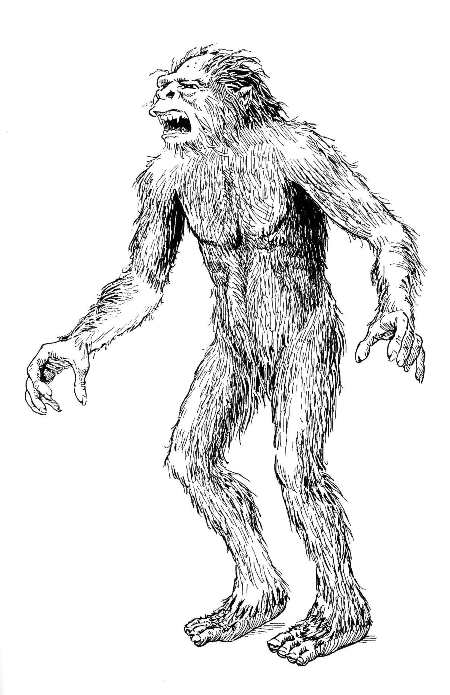
We saw this earlier on in the year with "verkaased" which gazelled into "be-cheesed", to become like cheese. Vergrendeled works in much the same way, as it turns the object being refered to into Grendel, the horribly disfigured mythical monster as featured in the epic Poem "Beowulf". To give an impression of what this may look like, let's get into a quick gallery of images of Grendel over the years. So, while there may be some historical discrepancy about what Grendel actually looked like, we can all agree that his appearance was not something to be desired.
Remember that tale about when you make a funny face, if the wind changes, you face will stay that way? Well, that is a classic example of being vergrendeled. Of course, objects can become vergrendeled too. The first time I heard it I was at a printer store, and a lady complained to the staff:
"My computer is ver-grendeled. Can you come and help"
I had a very graphic image of the computer being horribly disfigured and screaming insanely, which is kind of appropriate.
So, basically, anything that becomes misshapen or stuck in an undesirable way could be vergrendeled. This could be anything from a crashed computer, a skipping CD, a cake which has risen too much, two peaches that have grown into one, a particularly bad car accident, anything like that. The Gazellish way of thinking allows an undesirable situation become a much more descriptive one.
Example Sentence:
"This guy has been totally vergrendeled. What a sucker."
I will start with quoting comedian Demetri Martin:
"I think they named oranges before they named carrots. What are these? ...Oranges. What about these? (Oh shit)... Long Pointies? ..."
Left behind is the colour orange, which, by judging from what I see around me, is probably the most important colour in the world. It surely deserves its own name. So, my solution is to import the Dutch word "oranje" into the English lexicon. Because, I mean, Holland pretty much owns the colour. Besides, calling an entire colour (and even a secondary colour at that) after something from the real world is pretty stupid. We can't degenerate the colour to the same level as the made-up "salmon".
It is weird that Holland has an entire colour that we call our own. I mean, the Dutch basically own everything that has a visible spectrum at a wavelength of about 585–620 nm, and a hue of 30° in HSV colour space. To my knowldge, there is no other country that has this phenomenom. Sure, every country has its national colours, but they have to share it with other countries (suckers). However, to my knowledge, the colours purple and pink are still available. So, if some country that noone really cares about, say, Uruguay, just decided to clothe all their athletes in baby pink, that would be a really great way to gain recognition in the world.
Of course, the spelling of oranje would have to change, otherwise people would say "oran-gee", which would be retarded. (I had friends who said they enjoyed drinking "Onan-gee-boom". I had to think really hard about it before I realised what he meant.) There is a logical reason why oron-yeh has become the symbolic colour of Holland. It has something to do with kicking Spain's ass a few hundred years ago. [Foreshadow] In fact, Orange would probably still be on our national flag were it not for one small detail. From Wikipedia:
"The first stadtholder of the Dutch Republic was William I of Orange, who joined with Dutch nationalists and led the struggle for independence from Spain. Partly out of respect for him, the first flag adopted by the Dutch was a horizontal tricolour of orange, white, and blue. It became known as the Prinsenvlag ("Prince's flag") and was based on the livery of William of Orange. The orange dye was particularly unstable and tended to turn red after a while, so in the mid-17th century, red was made the official colour."
I think with all the other countries who have tried to copy the Dutch flag, and now that we have colourfast oron-yeh dies, we could well revert back to the original flag. Not that it is neccessary, as oron-yeh is already our own colour. In summation, a colour, so important and with such a history, should not continually be referred to by simply the name of a fruit.
Way-kah is the Dutch pronounciation of WK, which stands for Wereld Kampionschap (World champoinship). In Dutch it would sound very strange to say "cup", as this usually refers to single portions of salad dressing, or bra sizes. Being a football country, there is never any doubt as to which sport this Way-kah concerns. This is ingrained into Dutch youth, no matter where in the world they are raised. The contraction is necessary because it reduces the amount of syllables from six, to just two. And considering how often the Dutch talk about the World Cup, this contraction probably adds a few percentage points to the GDP.
In English, "World Cup", contains only two syllables, so a contraction is hardly necessary, not to mention that the contraction would then be "WC" which has four syllables and is the place where you defecate. However, other than in England, saying "the World Cup" wouldn't always refer to football (or the blasphemous word "soccer"... urgh.) This could refer to hundreds of different sports, all trying to cash in on the World Cup name. Just take a look at this list. Some of these sports are even made-up sports. I mean, what the hell is "bandying"? And no, I will not give "bandying" the dignity to take 3 seconds out of my life to wikipedia it. It's the principle of the matter. Because as much as I love a few other sports, only football has the potential to be a true world-sport. Even the bigger sports such as baseball, rugby and basketball have a very limited amount of countries who even stand a chance.
Therefore, a single word to refer to the football world cup is probably a good idea. Of course, this would only be temporary, until there is no doubt in any English-speaking country that there is only one World Cup, and that is for football. Because you know it is coming. So, in times of doubt, refer to it in its Dutch. The way-kah. It will be especially relevant if we are the winners this year.
Example Sentence: "The Brazilians had a big wah at the way-kah."
Bonus: Way-kah might be even easier to remember thanks to Shakira's annoying Waka-Waka song. In her wierd Cher-like voice, she almost even pronounces "Waka" similar to "way-kah".
(Although annoying as this Shakira song is, it is a thousand times better than the annoying official FIFA song, whose lyrics are "wooo-yo-oh-ye-oh" and "Wave your flag Wave your flag Wave your flag Wave your flag Wave your flag Wave your flag Wave your flag Wave your flag Wave your flag Wave your flag Wave your flag Wave your flag Wave your flag Wave your flag Wave your flag Wave your flag Wave your flag Wave your flag Wave your flag Wave your flag" Seriouslt, these lyrics are as annoying, repetitive and ADD as the goddamn vuvuzela. Thank you Africa.)
Bonus number two: Here are some images of the way-kah crazyness in Holland right now. There is no doubt here as to which sport the WK belongs to. I mean it is "the" World Cup, not "a" World Cup. You would think that this is a shop that sells orange things. No, this is a bank. Paint it Orange.
Part of the FIFA goal this Way-kah, as shown before the anthems, is the campaign "Say no to Racism"... Unless it is against the Japanese. (Or, say "yes to Nationalizm!")
You would think that these are just some drunken fans, but they are in fact our Prime Minister and his husband.
And here is another photo of our Prime Minister and his husband. Hup Holland!
There are a few words in every language which give a certain insight into how the speakers of that language think, and this is one of them. In Dutch, they use the same word "gelukkig" for "happy" and "lucky".
This is only a hunch of mine, but I have the feeling that many English speakers feel like they 'have a right to happiness". You often see this on TV, especially with new-age types, spoiled rich children, overprotective parents and - worst of all - psychologists. They act as if being happy is in the Ten Commandments or Magna freaking Carta. Let us take a quick look at the commonly accepted list of human rights (from : Wikipedia)
While the exclusion of any of these things may be a direct cause of unhappyness, there is nothing on this list that in itself will make you truly happy. These following things are not human rights:
Yet, these are all wonderful things that we should cherish for as long as we possibly can. In Dutch, any time someone says they are happy, they are in essence saying that they are lucky; or that they are lucky to be happy. The combination of these two words achieves two important things. It allows us to remain realistic and optomistic when things aren't going our way, and it makes us appreciate happiness that little bit more, however fleeting it may be.
So try to substitute the word "lucky" the next time you mean "happy", and who knows, you might be a little happier for it. I mean, Holland doesn't rank near the top of world happiness rankings for nothing. I can tell you that from my personal experience, it helps.
The Dutch language may be small and insignificant - much like the country itself - but it can offer so much. We here at The Weekly Gazelle believe that certain words like "Gezellig" can't be translated, so why bother? By learning to use certain Dutch words and contexts in English, we can expand our vocabulary. So English speakers, start using these words in your everyday lives, and Dutch people stop translating the impossible. In this way, our hope is that one day, we can all have a gazelle.
[First time readers are recommended to refer to the first post - Gazelle - first.]